4.05.2020
Telling stories and exercising our mouths!
We can exercise the speech organs while telling a short story or a fairy tale with a simple plot. After hearing a fragment of the text, the child imitates the movements of the lips and tongue. At first, show the child how to position the speech organs and what movements to make. Encourage the little one to imitate these movements (at first, it’s best to do this in front of a mirror).
We hope the children will enjoy the story about a little mouse:
Little Mousie
Early in the morning, little Mousie came out of her hole in search of adventure (stick your tongue far out). She looks around curiously (lick around your wide-open mouth). She wonders which way to go for a walk: left (touch the left corner of your lips with your tongue) or right (touch the right corner of your lips with your tongue). She went left and came into a big forest. She looks around (lick your lips), looks up at the cones growing on the trees (touch your upper lip with your tongue) and down at the soft moss (stretch your tongue down towards your chin). In the distance she can hear forest birds. The little mouse tries to imitate them:
– cuckoo, cuckoo, cuckoo – that’s how the cuckoo calls
– hoo-hoo, hoo-hoo, hoo-hoo – now we can hear an owl
– knock, knock, knock – that’s a woodpecker tapping on the trees.
After a short walk Mousie reached a clearing. She felt tired and hungry. She took her breakfast out of her bag and started eating (imitate chewing). After eating, the little mouse licks her whiskers (lick your upper lip) and her teeth (lick your upper and lower teeth). It was getting late, so Mousie decided to go home. And there a surprise was waiting for her. Guests had come to visit:
– a hen (cluck, cluck, cluck, cluck),
– a frog (ribbit, ribbit, ribbit, ribbit)
and a duckling (quack, quack, quack, quack).
Mousie greeted them warmly (blow kisses from the fingers of both hands with a smacking sound). She offered them tea, but it was hot. The guests had to blow hard to cool it down (blow a few times: breathe in through your nose, out through your mouth). When evening came, the guests said goodbye to Mousie (blow kisses from the fingers of both hands). The little mouse went to the bathroom to wash. She brushed her teeth (lick your upper and lower teeth) and rinsed her mouth (fill your mouth with air and move your cheeks). Then she put on her pyjamas and went to bed (snoring).
Good night, Mousie!
You can combine the speech exercises with drawing a mouse:
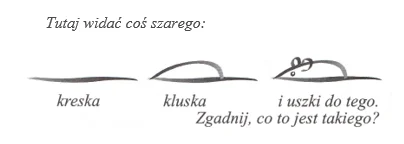
(adapted from: W. Szuman (1999) Rysowane wierszyki, Warsaw: WSiP)
You can find ideas for other speech therapy games that exercise the speech organs in these (Polish) books:
Anna Tońska-Mrowiec, “Języczkowe przygody i inne bajeczki logopedyczne”
Iwona Rutkowska-Błachnio, “Gimnastyka buzi na wesoło”
We also encourage you to make up your own short or longer stories (depending on the child’s abilities). When playing with young children who do not speak yet, include elements in the stories that encourage them to imitate various sounds from their surroundings (sounds made by people, animals, vehicles, etc.).
֍ ֍ ֍ ֍ ֍
27.04.2020
Let’s discover RHYMES THAT EXERCISE TONGUES
Reading together can be a valuable activity for children and parents. Even the youngest children are very sensitive to the rhythm and melody of language.
Rhymes, counting games and finger plays contribute significantly to a child’s speech development.
We recommend this (Polish) book:
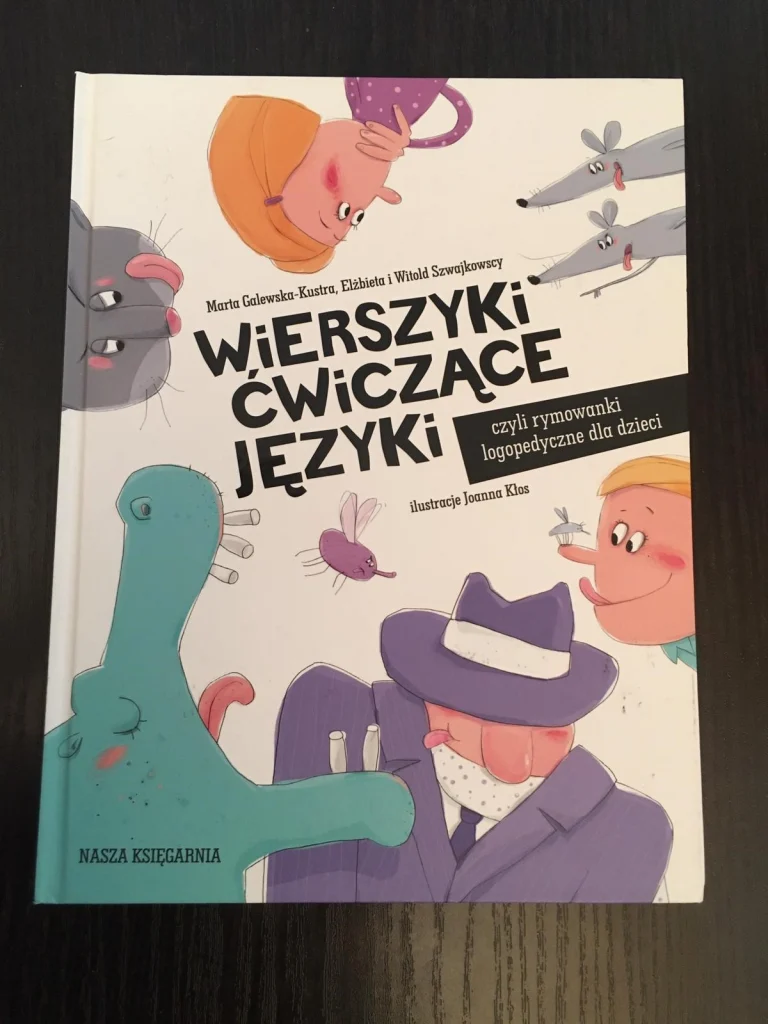
It is a collection of funny rhymes that develop articulation skills, presented in an attractive way that children find interesting. Here are a few examples:
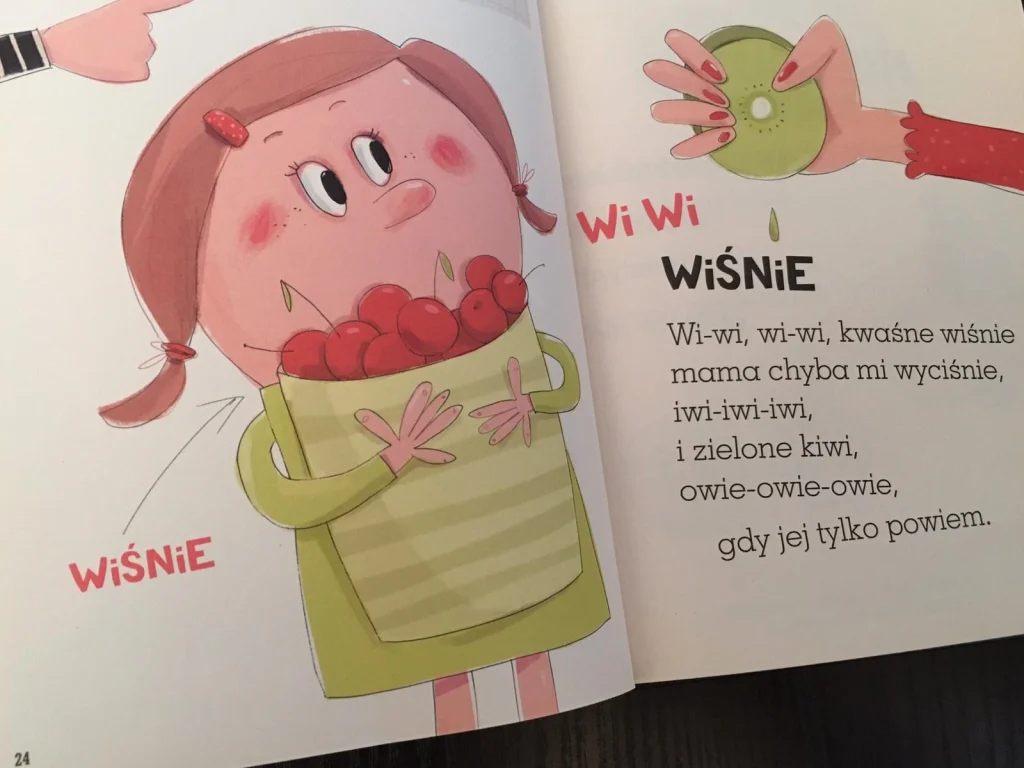
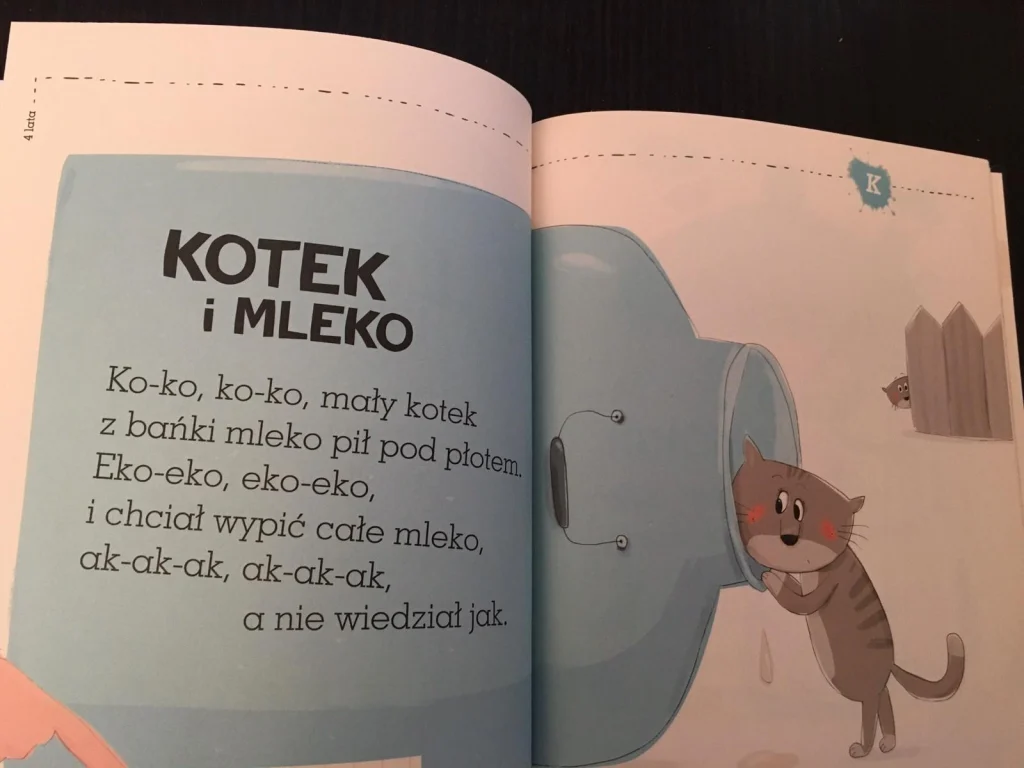
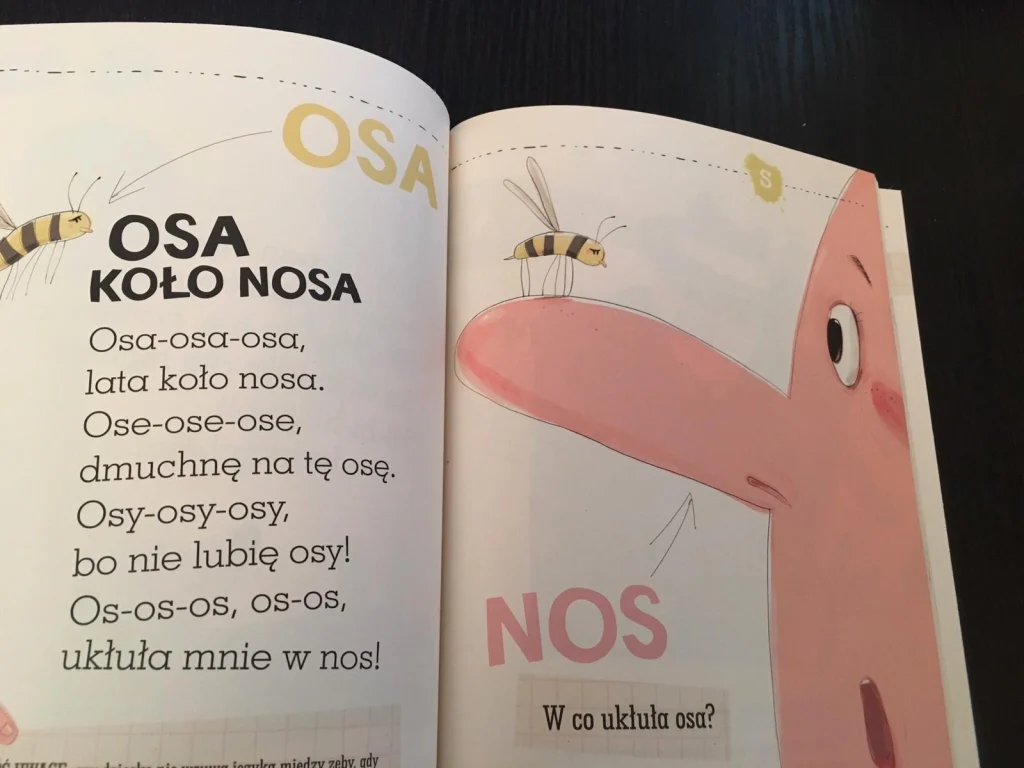
֍ ֍ ֍ ֍ ֍
24.04.2020
Exercise your mouth, speak better!
Start speech organ exercises with the ones that are easiest for the child and gradually make them harder. Some tasks require more skill. If the child doesn’t want to try them, let them watch your mouth – perhaps in time they will want to try to imitate you.
At first, you can use natural, everyday situations for the exercises:
- Make a smacking sound when blowing kisses.
- Spread some honey, chocolate spread or powdered milk on the child’s lips (watch out for allergens) and ask them to lick it off thoroughly like a teddy bear or a kitten.
- After a meal, let the child lick the plate or spoon like a kitten. It’s not the most elegant exercise, but it’s a very effective workout for the tongue.
- When the child yawns, use the moment: imitate the yawn and cover your mouth. You can repeat it with a comment like “What a big yawn!” – the child will spontaneously join in.
- Encourage the child to blow on a plate or spoon of warm soup, porridge or other food.

- Play at blowing light objects floating in the bath or a bowl.
- Pretend to breathe on cold hands to warm them up.
Biting and chewing food, and even sticking out the tongue, are also exercises for the articulatory organs!
֍ ֍ ֍ ֍ ֍
16.04.2020
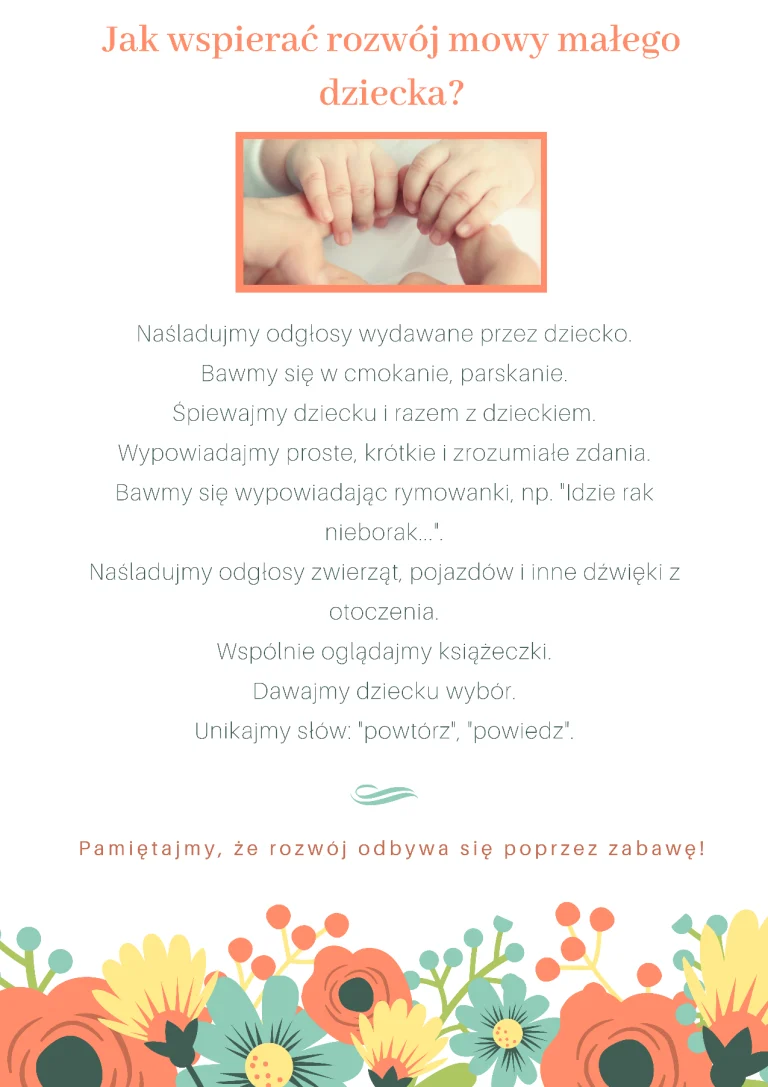
Prepared by Aleksandra Kmita
֍ ֍ ֍ ֍ ֍
30.03.2020
Blowing helps us speak!
To develop correct breathing, children can blow on:
- soap bubbles,
- pinwheels,
- bits of cotton wool or paper (they can also blow on them through a straw),
- leaves and feathers,
- toy flutes and whistles,
- small balls, paper balls, etc.
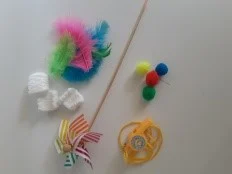
Balls can also be used for the following game:
Build a goal (e.g. from three boxes or large blocks). The child scrunches up a small, light paper ball and “scores goals” by blowing the “ball” into the goal. The goal should be about 30–40 cm from the ball.
You can also make your own blowing toys: tie light objects with threads to a straw or a stick and blow on them from different distances.
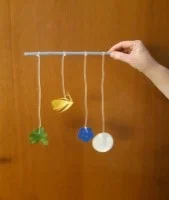
Remember not to make breathing games too long. Breathe in through the nose and out through the mouth. Combine breathing exercises with movement or weave them into the child’s various activities. These games are a great idea for doing something together and encourage the child to imitate.
֍ ֍ ֍ ֍ ֍