There is no single right therapeutic method to support a young child whose development is disturbed. Each child develops at their own pace and has their own talents, difficulties, interests and specific needs.
The range of therapeutic methods keeps growing. Their aim is to help bring out the child’s full developmental potential so that in the future they can live a dignified and happy life.
The choice of methods should always be adapted to the child’s individual abilities. In group work at the Early Intervention Centre we use the following methods:
1. The M. and Ch. Knill method
Used in many countries, it makes it possible to establish contact with people who seem not to seek it. The main aim of the programmes is to increase the activity of the person with a disability and to encourage them to act and show their own initiative (Ch. Knill 1997). The right conditions, and above all a sense of security, help the child to focus their attention and to gain experience related to their body. Music is an important element of the activity programmes: it gives the sessions a structure and allows the child to recognise what is about to happen.
2. Non-directive play therapy
A therapeutic method developed by Virginia Axline that gives the child the conditions for free play. Axline believed that play is the child’s natural means of expression and a way of “being themselves” in an atmosphere of acceptance and trust. Through play the child reveals their feelings and learns to name and control them. The therapist observes the child and analyses their behaviour, trying not to impose or direct the play, because otherwise the child loses their sense of agency, which is already limited by developmental difficulties.
3. Manual therapy
These sessions serve many therapeutic and developmental purposes. Manual work encourages activity because the art materials and tools are adapted to the abilities and needs of each child. All kinds of art activities improve manual skills and hand praxis. By handling, exploring and transforming art materials, the child “exercises” their hands, fingers and precision of grip and improves hand-eye coordination. Contact with materials of different textures and structures provides many tactile sensations and stimulates deep sensation receptors.
4. The Edyta Gruszczyk-Kolczyńska method
The aim of the method is to support the intellectual development of preschool children. How effectively development is supported, and the results of mathematical education, depend on matching the content to the children’s intellectual abilities. Mathematical concepts are formed continuously, mainly in natural everyday situations, whenever an opportunity arises. According to E. Gruszczyk-Kolczyńska, it is a programme for preschools, reception classes and integrated facilities. The content is divided into 12 thematic blocks:
- Spatial orientation.
- Rhythms and the rhythmic organisation of time.
- Cause and effect. Predicting consequences.
- Learning to count objects.
- Adding and subtracting, handing out and sharing out several items at a time.
- Classification.
- Helping children understand that the number of elements in a set stays the same even when they see changes suggesting there are more or fewer. Equinumerosity. Introducing the cardinal aspect of number.
- Putting things in order, numbering. Introducing the ordinal aspect of number.
- Length: learning to measure and helping children understand that length stays the same.
- Geometric intuitions.
- Building children’s emotional resilience and capacity for intellectual effort.
- Helping children understand that the amount of liquid stays the same, even though after pouring it seems that there is more or less.
5. Developmental Movement
Created by Veronica Sherborne in the 1960s. The activities come from rough-and-tumble play, which grows out of the child’s natural needs and takes place in contact with adults.
The basic idea of the method is to develop through movement: body awareness, awareness of space and of acting in it, and the ability to share space with other people. Sherborne activities give the child the opportunity to get to know their own body, improve motor skills and feel their own strength and agency, which in turn increases their movement abilities. The activities provide sensations related to balance, kinaesthetic and tactile sensations, and develop awareness of space and of acting in it, of sharing space with others and of making contact with them.
6. Félicie Affolter’s “Guided Interaction” method
This method is intended for people who, for various reasons, have difficulty planning and carrying out simple movements. The therapist places their hands on the back of the child’s hands and gently guides them through various activities, such as cutting bread or modelling with plasticine.
The child is not simply led: they should have a sense of agency, and the therapist’s hands help to give direction and reinforce the movement pattern. Working with the hands supports the development of hand-eye coordination, improves fine motor skills, helps the child make contact with the therapist and then with other people, and develops self-care skills.
7. Move to Learn perceptual-motor programme
A method developed by Barbara Pheloung, a developmental researcher who worked with children with developmental disorders for more than 30 years. Move to Learn was created to support the maturation of the child’s nervous system and so make effective learning possible.
The programme consists of a fixed sequence of 10 movements that the children master during the sessions. A new movement is introduced only when the child has mastered the previous one. Each session starts with a warm-up. The movements of the programme reflect primitive reflexes, whose integration allows healthy development.
8. Multisensory room – Snoezelen
Snoezelen is a therapeutic method based on non-directive multisensory stimulation. It was created in the Netherlands in the 1970s in response to the needs of people with profound intellectual disabilities. Today it is known around the world as a Multi-Sensory Environment. The main therapeutic tool is a specially equipped room that provides a variety of stimulation, depending on individual needs.
9. The Good Start Method
Developed by Prof. M. Bogdanowicz, the Good Start Method is intended for preschool and early school-age children whose psychomotor development is slower or uneven. It develops visual, auditory, language, tactile-kinaesthetic and motor functions at the same time, together with their cooperation, i.e. perceptual-motor integration (Bogdanowicz 1987). It also aims to establish lateralisation and orientation in the body schema. Exercises improving these functions are recommended for children getting ready to learn to read and write and for children with delayed psychomotor development or intellectual and physical disabilities.
10. Morning circle – multisensory stimulation through the seasons
A therapeutic method developed by Jacek Kielin for children with severe and profound intellectual disabilities. The programme is built around the natural world, which inspires symbols representing the elements, colours, smells, tastes, and tactile and thermal sensations. The main stimulus of the sessions is visual: the teacher-therapist, whose body language and facial expressions are the main channels of communication for people with profound disabilities.
11. Music therapy
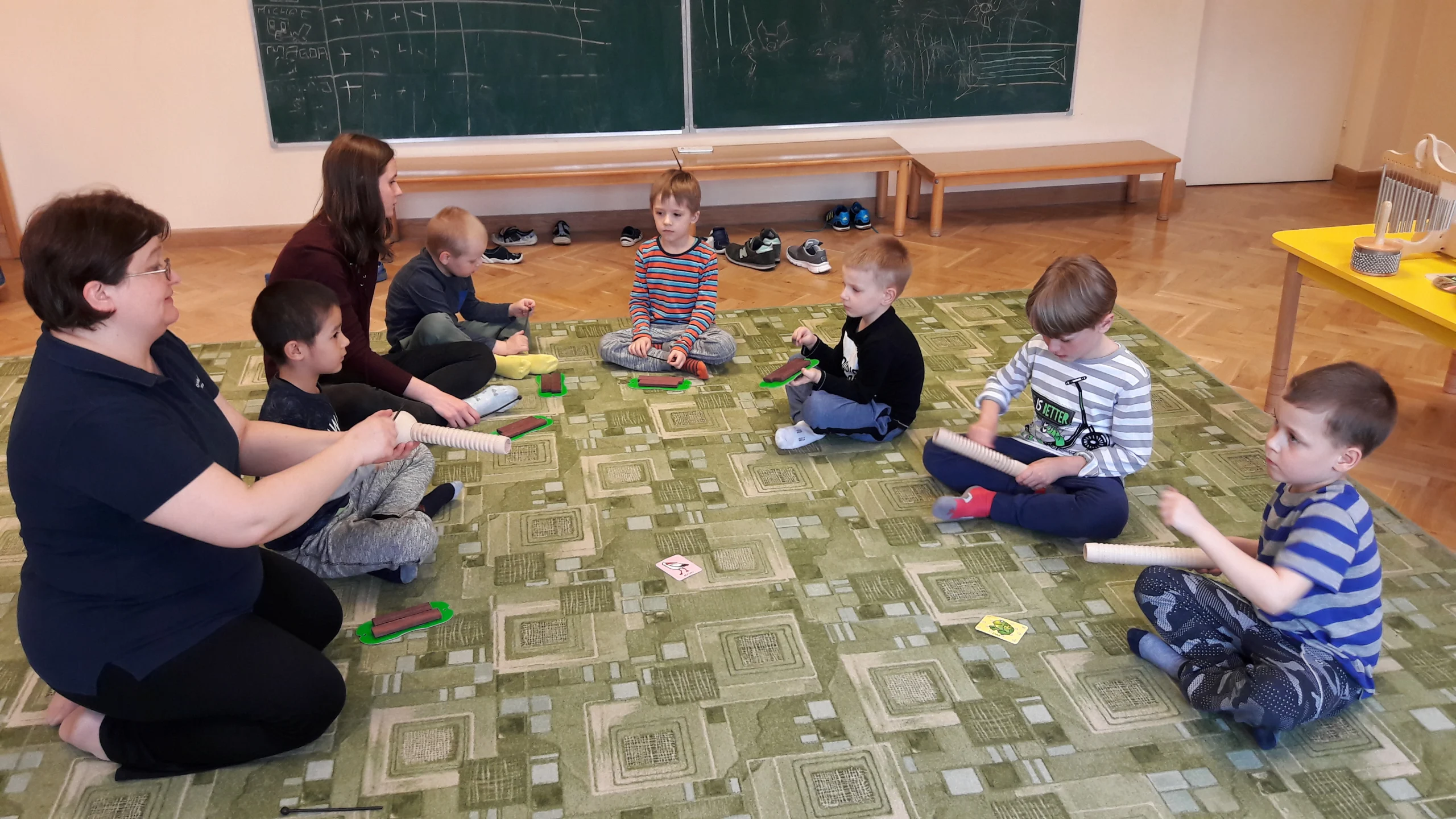
One of the arts therapies. It supports the child’s overall development: physical, intellectual, emotional and aesthetic, and is also used as a tool for relaxation. Music therapy can be receptive or active. Receptive music therapy involves listening to music and experiencing it; active music therapy includes singing and dance-movement therapy. It is used with children with developmental delays, early childhood autism, behavioural disorders, neuroses and physical disabilities.
12. Functional adaptation
These are group sessions. Their main aim is to prepare children for everyday tasks and various social roles, and to generalise the skills learned in individual sessions by practising them in a group. The sessions are organised around themes of interest and focus on developing skills such as self-care, communication, socialisation and cognitive activity.
13. Hand therapy
Hand therapy develops or restores hand function, i.e. the ability to use the hands effectively when grasping and manipulating objects during everyday activities, play and learning. It is based on neurodevelopmental methods that take into account the stages of gross and fine motor development, perceptual, cognitive and emotional-motivational functions, and the stages of development of drawing lines, pictures and the skills needed to learn to write.
Hand therapy is therefore intended for children who have difficulty with manual activities and precise hand work. These are often children who:
- find self-care activities harder, such as dressing, using cutlery or using the toilet and bathing,
- have abnormal muscle tone,
- use only one hand for activities that require both,
- find it difficult to choose a hand for precise tasks,
- have trouble adjusting the right amount of force when grasping and manipulating objects,
- seem careless when playing with objects, painting, cutting or gluing,
- have weaker hand-eye coordination (they find activities that require the eyes and hands to work together harder), e.g. throwing and catching a ball, doing puzzles or threading beads,
- have sensory difficulties (they avoid touching certain textures, materials or consistencies),
- do not like art or construction activities, avoid drawing or draw “messily”, or hold a pencil too loosely or too tightly.
14. Multisensory stimulation group
The group provides various sensory stimuli (tactile, olfactory, gustatory and visual), which help children correctly perceive sensations from the world around them and from their own bodies. The meetings take place in an atmosphere that builds a sense of security.
15. Speech-and-education group
The group aims at:
- developing receptive and expressive vocabulary based on the session topics,
- developing understanding of instructions by supporting communication with gestures,
- imitating gestures and simple exercises of the articulatory organs,
- repeating onomatopoeic expressions,
- learning songs and rhymes with gestures that develop auditory memory and attention,
- recognising sounds and noises from the environment,
- developing awareness of rhythm and tempo,
- introducing breathing and voice games.
16. Social Skills Training
A therapy for children who have difficulties with social functioning.
Group social skills training helps children with disabilities acquire the skills needed for:
- widening their circles of interaction;
- learning behaviour appropriate to the situation;
- following accepted conventions and limits (social norms);
- developing cooperation skills;
- noticing and responding to other people’s actions; following instructions;
- waiting for their turn and taking turns;
- persevering with an activity;
- functioning independently in changing conditions;
- developing interpersonal skills in different relationships;
- knowing and understanding many different emotions and knowing how to deal with other people’s emotions;
- understanding reciprocity as part of cooperation and negotiation;
- using appropriate problem-solving strategies; becoming aware of their own feelings, thoughts and needs in social interactions;
- developing an effective, socially accepted repertoire of social behaviour, and generalising the skills learned to various life situations.
Group social skills training prepares children for various social roles (preschooler, pupil) and for taking part in the life of a wider social group in their local community.
17. “You and Me” sessions
A place for young children and their accompanying parents/carers to meet, play and talk. In the presence of a close person who gives them a sense of security, the child gains social experience, learns to build relationships with children and adults and strengthens their communication skills. The sessions are based on free play with elements of guided activity: movement, music and art games. Each meeting has a welcome and goodbye ritual, which gives children a sense of stability and security.
18. Psychomotor therapy
Psychomotor therapy is one of the neurodevelopmental methods. It was developed from the experience of Belgian physiotherapists inspired by the work of the Polish neuropaediatrician Dr Zofia Kułakowska.
Psychomotor therapy supports children with motor difficulties and emotional and social problems. It is based on repeating the same tasks many times and on learning and remembering the desired activity.
The aim and effect of the sessions is to build or activate the neural networks responsible for integration processes in the brain.
The sessions are intended for children aged 3–7 with functional difficulties caused by minimal brain dysfunction resulting from abnormal maturation of the brain’s integrative structures (responsible, among other things, for somatognosia, speech and behaviour, as well as dyslexia-type difficulties). The method is particularly useful for children who show:
- difficulties with motor activities, e.g. clumsiness, tiring quickly, difficulty concentrating, poor or no motor coordination, poor balance reactions,
- clear difficulties with knowledge of the body schema,
- learning difficulties that cause problems at preschool and school (the child confuses colours, cannot name shapes, is reluctant to draw, has trouble reading, writing or counting),
- behavioural difficulties in the form of psychomotor hyperactivity or excessive passivity (children who are oversensitive, overactive, anxious, tearful, aggressive, etc.),
- lateralisation difficulties, i.e. no dominance of the left or right side of the body – e.g. using both hands equally for too long and not knowing left from right,
- delayed speech development and communication difficulties.
The sessions are run by two therapists at the same time: a physiotherapist and a second specialist – a speech therapist, psychologist or special educator. This pairing ensures that all the aims of the therapy are fully met.
The sessions take place in adapted rooms in small groups of children of a similar age, which makes it possible to address each child’s difficulties individually while giving them the opportunity to develop social and communication skills with their peers. The group motivates the children to make an effort, lets them compare themselves with others, and develops imitation and cooperation.
19. Video Interaction Training (VIT)
Video Interaction Training is short-term, intensive support for the family, focused on changing the interactions between parents and children. Its aim is to support parents’ skills, teach them the principles of good communication and help them use these skills to build positive contact with their child.
The work with the family is based on analysing video recordings of interactions. The trainer makes short 10–15-minute recordings in the child’s family home, in natural situations. At the next meeting the trainer and the parents discuss selected fragments of the film together. The trainer focuses on the positive aspects of the relationship, pointing out the parents’ strengths in reinforcing or eliciting the desired behaviour in their children. The work concentrates on interaction and communication processes in the family and on appropriate stimulation of the child’s development. Video Interaction Training is an effective method for all families in which contact with the child is more difficult because of developmental problems, especially children with speech development disorders, intellectual disability, autism or profound multiple disabilities; when parents report parenting difficulties; and preventively, when we want to strengthen emotional bonds, social sensitivity, problem-solving skills and a sense of competence.