Dear Parents and Carers,
The summer holidays are here! Thank you for working with us during this special and difficult year.
Believing that better times will come soon and that we will come through the current challenges stronger, we wish you plenty of strength, hope, sunshine outside and in your hearts, and rest, and we wish the children wonderful, healthy and safe holidays. May there be as much time as possible for joyful activities together and for lazing around 🙂.
To those we won’t see during our summer therapy sessions, we’re already saying:
See you in September!
19.05.2020
The magical world of autism
No two people are the same, no two experiences are the same, no two thoughts are the same. Every perception is different, even if its object seems one and the same for everyone. When we hear the word “red”, most of us picture a tulip, a rose or a ripe cherry. Most of us agree on what “red” is. But what if it turned out that red has a sound and a smell? And that it isn’t a smell associated with a flower or a fruit at all? What if the days of the week had particular shapes and colours? That’s not so obvious any more, is it? There is, however, a group of people who experience the world in a completely different, magical, extraordinary way. Our children. Children with autism. Let’s take a moment to look at this magic.
- Synaesthesia is the phenomenon that makes the experiences described above possible. Also called “cross-sensory perception”, this remarkable experience means that stimulating one sensory modality (the form in which a stimulus reaches the sense organs that take in information from the environment) triggers perception through another sense. The triggering stimulus is called the inducer and the resulting sensation the concurrent. For example, hearing sounds may cause the perception of smells or colours.
Although synaesthesia seems quite unusual, surprisingly we all have some tendency towards it. Look at the pictures below:
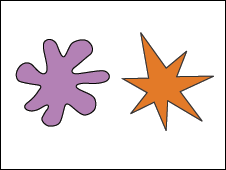
Which of the drawings is Bouba and which is Kiki? We bet the answer wasn’t difficult. Bouba is purple and Kiki is orange. How do we know? That’s synaesthesia.
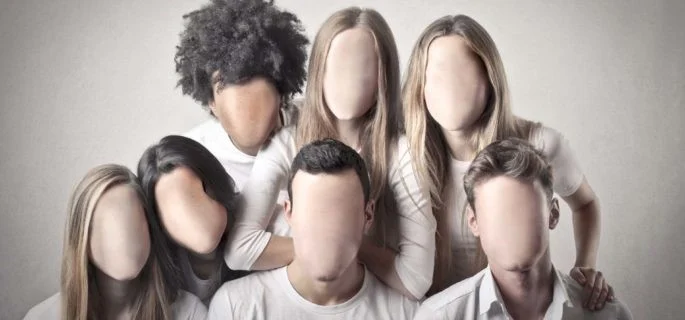
- Prosopagnosia. Have you ever met someone in the street who greeted you warmly, but you couldn’t for the life of you work out who they were? The face seems familiar, but you can’t remember where you know it from. It’s an awkward situation, especially when the person comes up and asks how it went yesterday. You break into a sweat, blush and turn pale by turns. You panic, wondering how on earth this person knows that you had an important job interview yesterday! Well, they know because they’re your husband, and you don’t recognise his face because you experience prosopagnosia. This strange perceptual difference, which occurs with autism but not only with autism (Brad Pitt is one celebrity who has it), is known as face blindness. It is the inability or difficulty to recognise familiar faces. Like autism, prosopagnosia lies on a continuum, from difficulty recognising faces outside one’s circle of friends and family to a state in which a person cannot identify their own face in the mirror or in photos. People with prosopagnosia use various strategies to recognise people close to them: by their walk, gestures, hair, smell, or a characteristic item of clothing or jewellery. Some believe that prosopagnosia is an important feature of autism, and of Asperger’s syndrome in particular. Temple Grandin, one of the world’s best-known autistic people, describes in her autobiographies how her prosopagnosia got her into awkward situations when she didn’t recognise acquaintances unless they had distinctive features such as glasses or a particular hairstyle.
Source: https://www.tenerifenews.com/
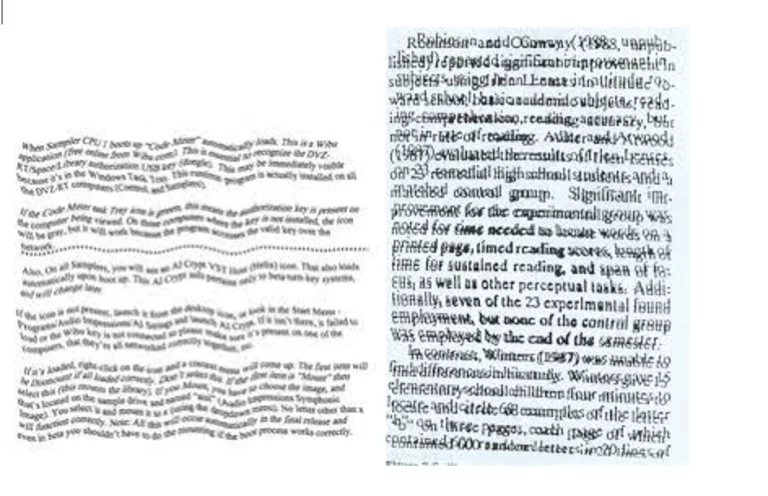
- Scotopic sensitivity / Irlen syndrome is another unusual feature of autistic perception. What your children see can play tricks on them. People with scotopic sensitivity see reality in a completely different way from most of us. It is a particular kind of visual perception that shows itself as sensitivity to light, contrast and colours; poor readability of print, which seems to move, shake, swirl, sparkle, shine or fade; and difficulties with depth perception. This causes a feeling of overload, tension and fatigue. There are ways to reduce this sensitivity with special glasses or lenses.
And this is how an image looks to eyes with scotopic sensitivity:
Autism is a different way of functioning, perceiving and thinking. Sometimes it is inaccessible to us, but at the same time it is full of richness. The only way to understand it is full acceptance and letting go of the assumption that our perception of the world is the only right one. Amanda Baggs, a non-speaking autistic person, writes on her blog that she uses the most beautiful language in the world – there just hasn’t been a translator for it yet.
WE SEE DIFFERENTLY, WE LOVE THE SAME
Each of us interprets the world through our own sensations, experiences and biological abilities. At the same time, we tend to take it for granted that others perceive reality the same way we do. This assumption seems right when we think of neurotypical people, like most of us. It’s different with autism. Different – not worse. We have deliberately used the term neurotypical (NT – neurologically typical) as one example of the many varieties of human diversity. Autism lies at one end of a continuum of this diversity as neurological atypicality. To understand autism and our children who are “equipped” with it, we should therefore let go of the neurotypical way of understanding reality and try to look at our children anew, without common judgements and expectations. Let’s simply observe…
For autistic people, autism is a way of being. It is all-pervasive and sets the tone for their experiences, impressions, observations, thoughts, emotions – almost every aspect of their existence. Our children don’t always react the way we sometimes expect them to, because they have different systems of perception and communication.
Sensory integration (SI) therapy, which is also used with autistic children, is based on the assumption that some people have difficulties receiving and processing sensory information, showing as increased or decreased sensitivity to stimuli. With autistic children, things look a little different. They are said to have different sensory experiences. To help you understand this phenomenon, we will describe some examples of these differences:
• literal perception – autistic people perceive the reality around them exactly as it is. When looking at objects, they often cannot interpret and understand their meaning. Our minds sometimes fall for illusions and fill in certain content. The mind of an autistic person is not fooled.
Here is an example:

This is an illusion that leads the neurotypical brain to misjudge the size of the circles in the middle of the patterns. We see them as different sizes, while in fact they are the same. Our perception depends on contrast, which is irrelevant for an autistic person. Your child will probably correctly see that the circles in the middle are the same size. Autistic people are masters at seeing through optical illusions.
• gestalt perception – your child may find it difficult to tell more important information from less important information. In other words, everything they perceive seems equally important. This has its strengths, as it means they notice and remember even the tiniest details. Gestalt perception means perceiving the whole scene as a whole, with all its details registered at the same time as equally important. Autistic people may pick up information that others miss, but processing a whole scene full of details can be overwhelming and exhausting.
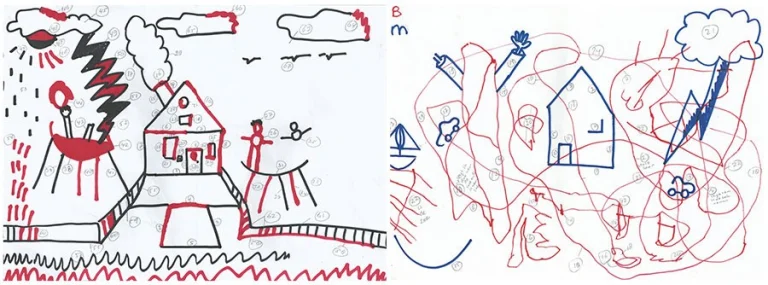
• fragmented perception – if too much information reaches your child at once, they may not be able to break this complex picture down into meaningful parts. They will probably find it difficult to interpret people and objects as important parts of the picture. Instead, they will process the fragments that catch their attention, which are not necessarily important for the scene as a whole.
An example of this difference is the drawings of a neurotypical 6-year-old (left) and an autistic 6-year-old (right):
Source: spectrumnews.org
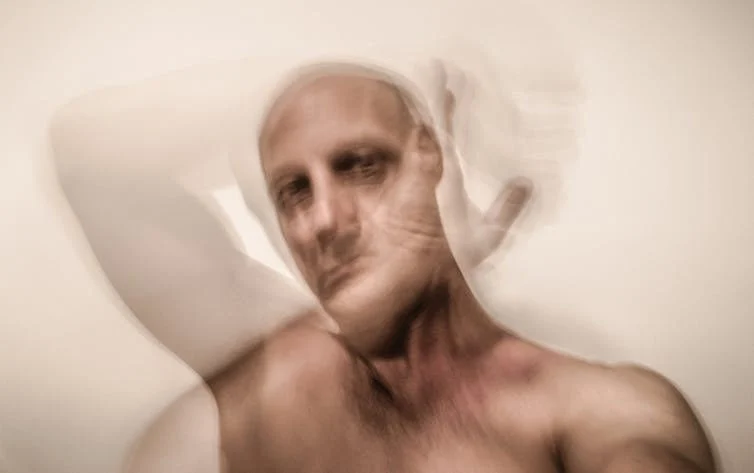
• distorted perception – your child may sometimes perceive reality in a completely different way, which can be compared to a reflection in a distorting mirror. The distortions usually concern the perception of depth and space, shapes, size and movement, two-dimensional vision and double vision.
So it is possible that this is how your child sees movement:
Source: theconversation.com
• delayed perception – as a result of fragmented perception, your child may process incoming sensory information with a delay, which in turn leads to a delayed reaction. So let’s not get angry when our son or daughter follows an instruction after a while. It isn’t laziness or disobedience… this is how the autistic brain works: it needs more time, so let’s give it that time.
• shutting down systems – anyone who spends a long time in a chemist’s or a shopping centre can feel tired of the noise, the harsh lighting or the many smells. We leave such a noisy space, with its fluorescent lights hurting our eyes, with relief and enjoy the peace. It’s harder for your child. They have nowhere to go to find relief, because really every place is a source of many sensory stimuli. So they cope by temporarily shutting down a sense to block painful or difficult sensory information. This may mean disconnecting sensory processing from thinking, feelings, bodily sensations or monitoring intentional expression. It may also mean shutting down the simultaneous processing of information in several sensory channels. Finally, it may mean shutting down information processing, so that your child accumulates “unknown” knowledge, which in practice means being less aware of knowing about a particular subject.
As we can see, perception in autistic people follows different rules from perception in neurotypical people, and we should respect this if we really want to get to know our child. Let’s end with the thought of the mother of an autistic boy in Lisa Genova’s novel “Love Anthony”: the autism spectrum is long and wide, we are all on it, and once you believe that, it’s easy to see how much we have in common.
This article is based on the book: Olga Bogdashina (2016). “Sensory Perceptual Issues in Autism and Asperger Syndrome: Different Sensory Experiences – Different Perceptual Worlds” (Polish edition: Gdańsk: Wydawnictwo Harmonia).
֍ ֍ ֍ ֍ ֍
14.04.2020
Spring is in full swing! Let’s listen to its sounds while #stayingathome.
https://coneixelriu.museudelter.cat/ocells.php
֍ ֍ ֍ ֍ ֍
April is Autism Awareness Month. What would you say if the rest of the year were declared a time of autism acceptance?
Autism is a condition characterised by a different perception of reality; it is not a disease. There are medicines for health problems that often accompany autism, such as epilepsy, allergies or gut flora disorders, but there is no cure for autism itself. So let’s try to look at our children from the perspective of their strengths, following the motto: if something cannot be changed, it should be accepted. Perhaps the myths about autism presented below will help you see the many dimensions of your child’s “uniqueness” and make it easier to accept their Beautiful Minds. (The illustrations below are in Polish.)

There is also emotional empathy. It helps us feel (“feel our way into”) another person’s emotions. When we engage affective empathy, we vicariously experience the emotional states of others, understanding that these feelings are not our own but the other person’s. Compassion is also part of affective empathy. Seeing someone suffer makes us, in a way, share their suffering, and prompts us to act to ease the other person’s pain.
Unfortunately, failing to see the difference between affective and cognitive empathy has led to a persistent myth and stereotype that autistic people lack empathy and do not understand their own and other people’s feelings.
Autism does not take away emotional empathy! Autistic people can experience feelings and emotions just as intensely as everyone else. It isn’t always obvious to us, though, because they sometimes show them in an “unusual” way.

Liking, acquaintance, friendship and love are just as precious to autistic people as they are to us. They need them just as much, and they are the goal of their social activity. The difference lies in the degree of involvement and in understanding the nuances of relationships. Autistic people form lasting and meaningful friendships, but they don’t need contact as intense and frequent as we do. They value time with friends, but time spent alone, pursuing their own interests and passions, is just as important to them. Autistic girls and women are able to build a wide network of social contacts; they just tend to opt out of the typical small talk and gossip, which they may not fully understand.

Clearly, only behaviours that are socially unacceptable and may threaten the safety of autistic people or those around them need to be reduced. Contrary to popular opinion, many of these activities are very “normal” and should not be treated as oddities. For autistic people, developing a passion sometimes becomes a way of life, including a way of earning a living. For example, autistic women often choose psychology, education, speech therapy, medicine, literature, art, languages, fashion, cosmetics, theatre or dance as the focus of their passions. Thanks to the intense commitment to their interests that is typical of autism, they achieve mastery in their field, become experts and very often succeed professionally.

Autism makes social functioning harder, but it does not rule out paid work on the open labour market. More and more IT companies employ autistic people because of their particular ability to notice details and discover relationships, procedures and systems. Silicon Valley, the best-known centre of the American high-tech sector and home to many multinational corporations, employs many autistic people. Recently, Mossad, the Israeli intelligence service, announced a special programme, Roim Rachok (Seeing Beyond the Horizon), which trains autistic people to analyse aerial and satellite images.
Autism is not a disease but a neurological difference in the perception of reality. So let Autism Awareness Month be an impulse to develop acceptance of neurodiversity, because that is where the richness and colour of our world lies 🙂
֍ ֍ ֍ ֍ ֍
02.04.2020
For several weeks now we have all had to stay at home. You have probably faced difficulties that you need to deal with. Even though the situation has been going on for some time, it still requires new ideas and solutions from all of us.
We are sometimes on edge; stress and anxiety appear. Let’s remember that this is a normal reaction in the current situation. If we allow ourselves to have these emotions, it will be easier to manage them.
Children may also feel lost and irritable. What can we do to get through this difficult time?
Try to reassure the children:
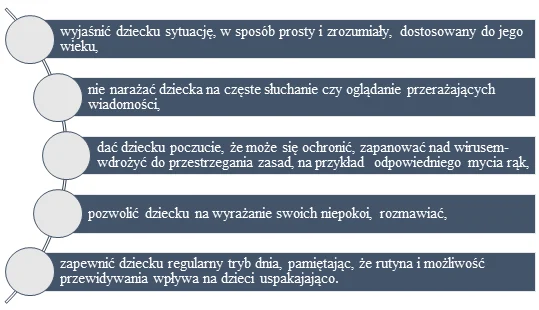
It helps if they eat meals and go to bed at regular times and know what will happen in the morning and what after lunch.
For children who use alternative communication, besides words, use the forms of visualisation they know (photos, pictograms, written words) to make the message easier to understand.
Try to organise your child’s time, remembering that it shouldn’t be a tight schedule:
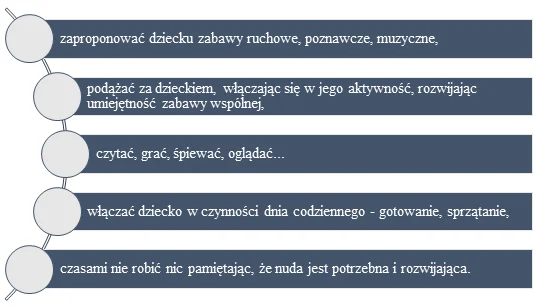
We know that being at home with your child in isolation for a long time is hard. So let yourself be guided above all by your own intuition. Every parent knows best what their child needs most – lots of activity or rather some calm.
We wish you good luck – we’ll get through this difficult time 😊
֍ ֍ ֍ ֍ ֍